That first sharp reminder often shows up at ordinary moments. You stand after a long meeting, step out of the car, or turn to go downstairs and your knee answers with pain, stiffness, or a feeling that something is not right.
For many people, the next thought is surgery. In practice, that is rarely the only path. A large share of knee pain responds well to a structured conservative plan that reduces irritation, restores strength, and improves the way the joint handles load.
Knee pain relief without surgery is not about collecting random tips from the internet. It works best when you follow a sequence. Calm the knee down. Figure out what is driving the pain. Rebuild strength and movement quality. Add the right support. Use medical options thoughtfully when symptoms persist.
That is how we approach knee recovery in physical therapy. The focus is not just pain control. The focus is getting you back to walking, training, working, climbing stairs, and living without constantly negotiating with your knee.
Your Guide to Lasting Knee Pain Relief
Knee pain changes behavior before people even realize it. They stop kneeling. They shorten walks. They shift more weight to the other side. They avoid the stairs at work and tell themselves they are just being careful.
That pattern matters. The less the knee moves well, the more surrounding muscles weaken. As those muscles lose strength, the joint handles force less efficiently. Pain often grows from there, even when the original irritation was manageable.
Why random fixes usually fall short
Many common self-treatment strategies help for a day or two but do not change the bigger picture. Rest alone can calm a flare but also leaves the leg weaker. A brace may make activity feel safer but cannot replace strength. Pain medication may reduce symptoms but does not teach the joint to move better.
A better plan treats knee pain as both a symptom and a movement problem. You need symptom control, but you also need the right amount of loading, the right exercise progression, and a clear sense of when to push and when to back off.
A painful knee usually needs less guesswork and more structure.
What a conservative care plan looks like
A good non-surgical program usually includes several parts working together:
- Early symptom management: Reduce swelling, irritation, and fear of movement without shutting activity down completely.
- Progressive exercise: Restore range of motion, wake up underused muscles, and rebuild strength around the knee and hip.
- Movement retraining: Improve walking, stairs, squatting, and getting up from a chair so daily tasks stop aggravating the joint.
- Smart support tools: Use bracing, footwear choices, and activity changes to reduce overload while recovery is underway.
- Medical support when needed: Add medications, injections, or newer procedures only when they fit the problem and the goals.
People often do best when they stop asking, “What is the one thing that fixes knee pain?” and start asking, “What sequence gives my knee the best chance to recover?”
That shift changes everything. It turns recovery from a passive wait-and-see process into a plan you can follow.
Assess Your Pain and Take Immediate Action
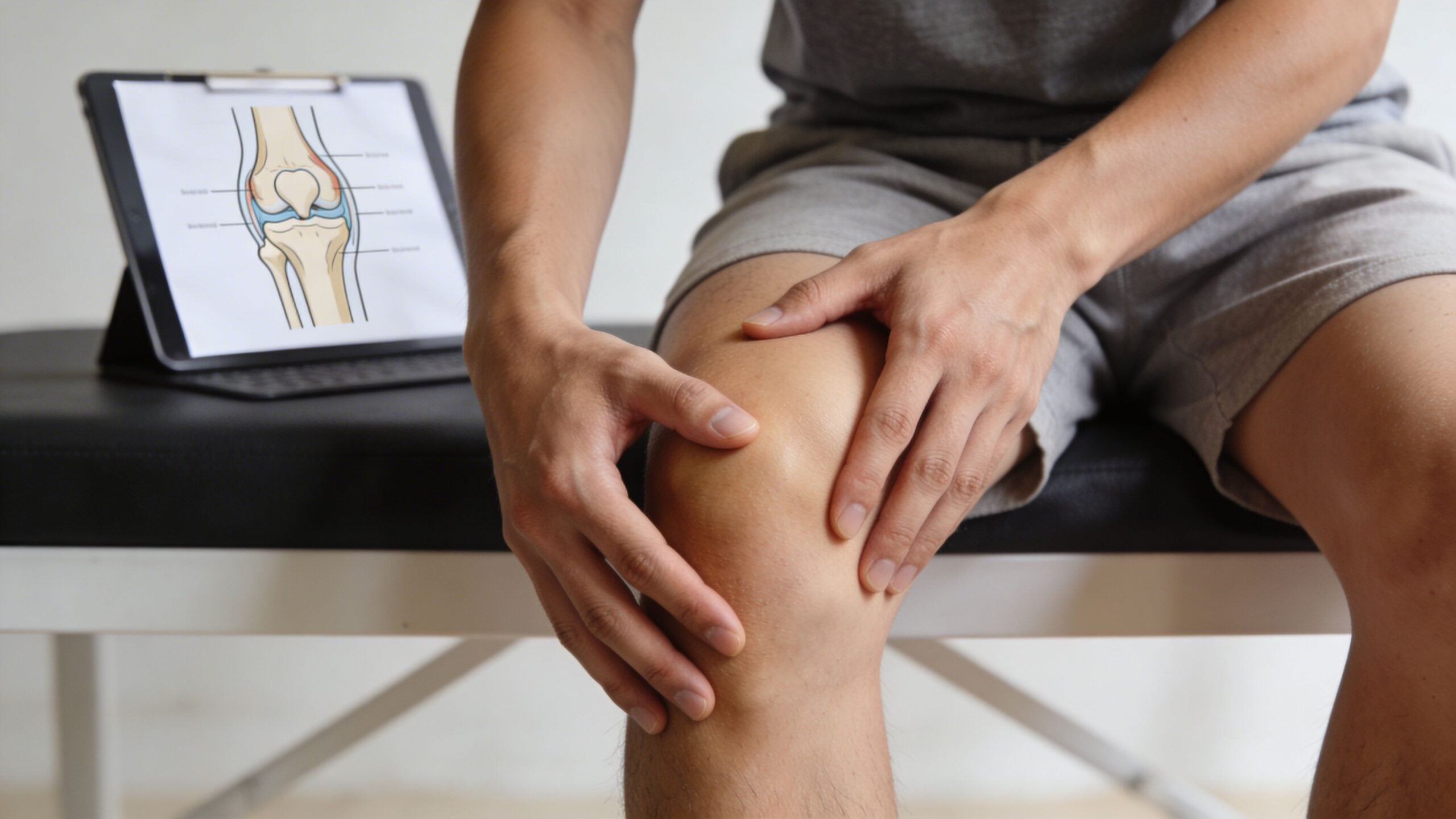
Not all knee pain should be managed the same way. Some cases respond well to home care for a few days. Others need prompt medical evaluation.
The first job is not to fix everything immediately. It is to sort urgency from irritation.
Red flags that need medical attention
Seek urgent medical care if any of these are present:
- You cannot bear weight: If the knee gives way or you cannot take several steps, that needs evaluation.
- Swelling appears quickly: Rapid swelling after a twist, fall, or impact can signal a more significant injury.
- You heard or felt a pop followed by instability: That combination raises concern beyond a simple strain.
- The joint locks: If you cannot fully bend or straighten the knee, do not force it.
- There is major deformity, fever, or significant redness and heat: These symptoms warrant prompt medical review.
If none of those apply, conservative care is often appropriate to start.
Use PEACE and LOVE instead of panic
Older advice often centered on prolonged rest and ice for nearly everything. A more modern approach is PEACE & LOVE, which balances short-term protection with early recovery.
PEACE works well in the first stage after a flare or minor injury:
- Protect: Reduce or pause movements that sharply increase pain.
- Elevate: If the knee is swollen, elevate it when practical.
- Avoid anti-inflammatories: Use medications only under appropriate guidance, especially early on, because symptom relief can sometimes encourage too much activity too soon.
- Compress: A simple wrap or sleeve can help manage swelling and improve confidence.
- Educate: Know that complete rest usually is not the answer.
Then shift toward LOVE:
- Load: Reintroduce movement gradually.
- Optimism: Pain is influenced by fear, uncertainty, and stress as well as tissue irritation.
- Vascularisation: Gentle walking, cycling, or pool work can calm a knee better than bed rest.
- Exercise: Build the capacity of the tissues so the pain is less likely to keep returning.
If you are deciding whether to use heat or cold during that early phase, this guide on heat vs cold compress can help you match the tool to the symptom pattern.
What to watch over the first few days
Use simple questions:
| Question | What it tells you |
|---|---|
| Is pain improving, unchanged, or worsening each day? | Recovery should trend in the right direction, even if slowly |
| Can you walk a little more normally today than yesterday? | Function often improves before pain fully settles |
| Does swelling rise sharply after activity? | The knee may be getting more load than it can currently handle |
| Does the knee feel stable? | Instability changes the plan and may require assessment sooner |
Some symptom relief starts with reducing overall irritation. Food quality, sleep, and stress all play a role. If you want practical lifestyle ideas, this resource on reducing inflammation naturally is useful as a complement to a movement plan.
Why gait matters early
One detail many people miss is the way they walk. Subtle movement changes can keep the knee irritated even when the original flare is calming down. Research has shown that small adjustments to foot angle during walking taught through gait retraining provided pain relief comparable to over-the-counter medications like ibuprofen and slowed cartilage degradation over one year (PMC review).
That does not mean you should try to reinvent your walking pattern on your own. It does mean your stride, cadence, foot angle, and leg control can matter more than commonly assumed.
If pain is tolerable and the knee is stable, gentle movement is usually more helpful than complete shutdown.
Build Strength with a Progressive Exercise Program
Movement is medicine for many knee problems, but only if it is dosed correctly. Too little load leaves the leg weak. Too much load creates repeated flare-ups that make people stop altogether.
The answer is progression. Start where the knee can succeed, then build from there.
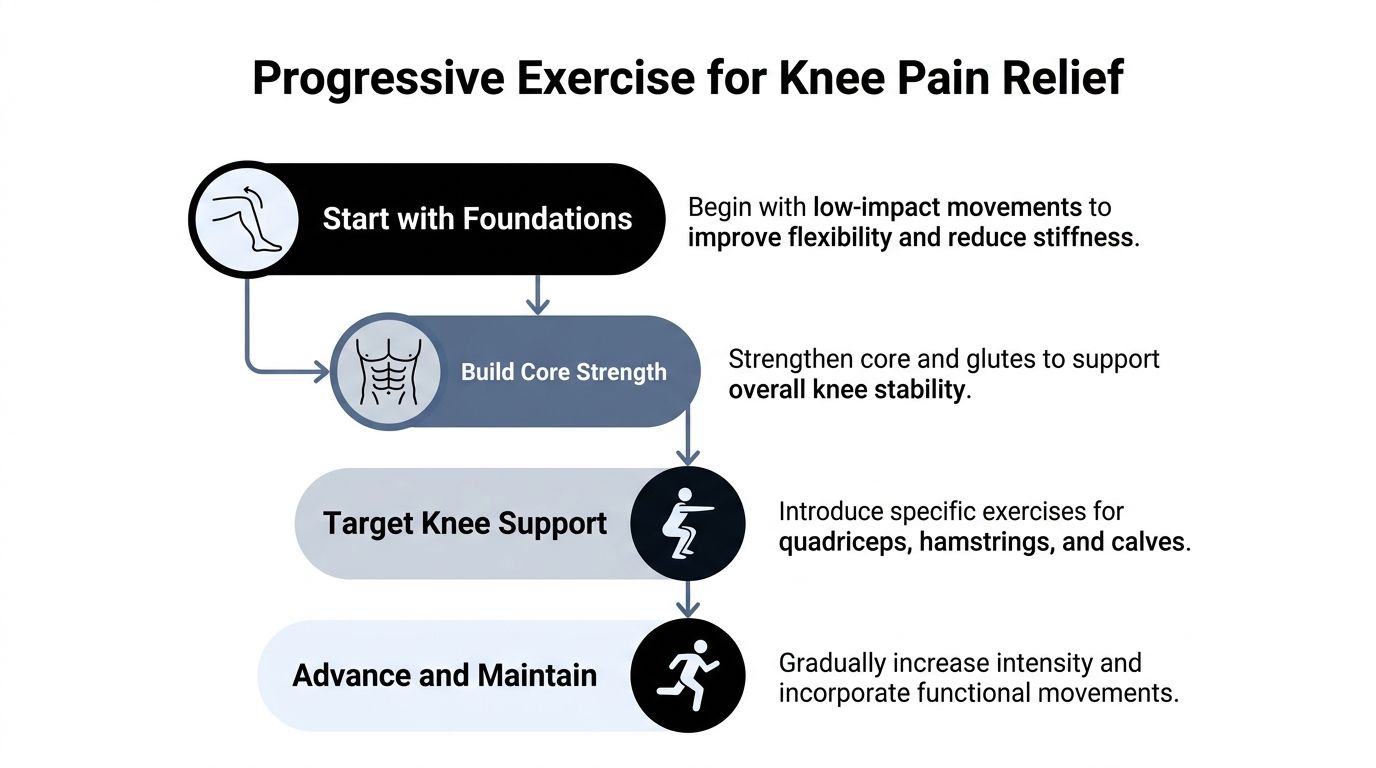
Phase 1 with mobility and muscle activation
Early exercise should lower threat, not spike it. This phase works well when the knee feels stiff, weak, or guarded.
Useful starting options include:
- Heel slides: Restore bend without forcing range.
- Quad sets: Tighten the front of the thigh with the leg straight.
- Straight leg raises: Build control if you can keep the knee steady.
- Short arc quads: Place a rolled towel under the knee and extend the leg partway.
- Calf pumps and ankle movement: Helpful when swelling and stiffness are part of the picture.
The goal is not exhaustion. It is getting the knee moving again and reconnecting the muscles that support it.
A common mistake is chasing a deep stretch or hard burn too early. If the knee swells more later that day or the next morning, the dose was probably too high.
Phase 2 with foundational strength
Once the knee tolerates basic movement, build strength where it counts. The knee rarely works alone. The hip, glutes, calf, and trunk all affect how force travels through the joint.
This middle phase often includes:
Sit-to-stands from a chair
Great for relearning a daily movement while building quadriceps and hip strength.Step-ups on a low step
Start with a small height and slow control. Do not rush the lowering phase.Bridges
These train the posterior chain, which helps reduce overload during stairs and walking.Standing terminal knee extensions with a band
A useful option for people who need better control near full extension.Side-stepping or clamshells
Hip strength matters because poor femur control can increase stress at the knee.
The best load is the one you can repeat consistently. A little soreness in the working muscles is normal. Joint pain that lingers or escalates is feedback to adjust.
A detailed knee rehab plan should account for diagnosis, irritability, and baseline function. If you want examples of how clinicians structure that process, this overview of rehabilitation for the knee is a helpful reference.
Phase 3 with functional movement
This phase prepares you for real life. Strong muscles on a treatment table do not automatically translate to pain-free stairs, hikes, or sports.
Functional progressions often include:
- Controlled squats to a box
- Split squats or supported lunges
- Single-leg balance with reach
- Farmer carries
- Lateral step-downs
- Return-to-impact drills for appropriate patients
At this point, quality matters more than complexity. A shallow, well-controlled squat is more valuable than a deep painful one. The knee should track smoothly. The trunk should stay organized. The foot should stay grounded.
Why supervision often changes results
Home exercises matter. Supervision matters too.
Supervised physical therapy has been observed to delay the need for total knee replacement for many patients and can lead to greater improvement in pain and function compared to receiving written instructions alone.
That tracks with what we see clinically. Many individuals do not fail because exercise is ineffective. They struggle because they progress too fast, stay too easy for too long, compensate around weak areas, or stop when pain fluctuates.
How to know if your program is working
Use function, not just pain, as your scoreboard.
Look for signs like:
- You stand up with less hesitation
- Stairs feel more predictable
- Your walking distance increases
- You recover faster after activity
- The knee feels stronger even if some symptoms remain
Strength work should make your world bigger, not smaller.
One practical option for people with painful loading is a formal knee osteoarthritis program that combines in-clinic visits, hands-on treatment, and guided exercise progression. Highbar Physical Therapy’s Joint Health Program is one example of that kind of structured conservative care, including individualized exercise and virtual support for ongoing management.
Support Recovery with Bracing and Activity Modification
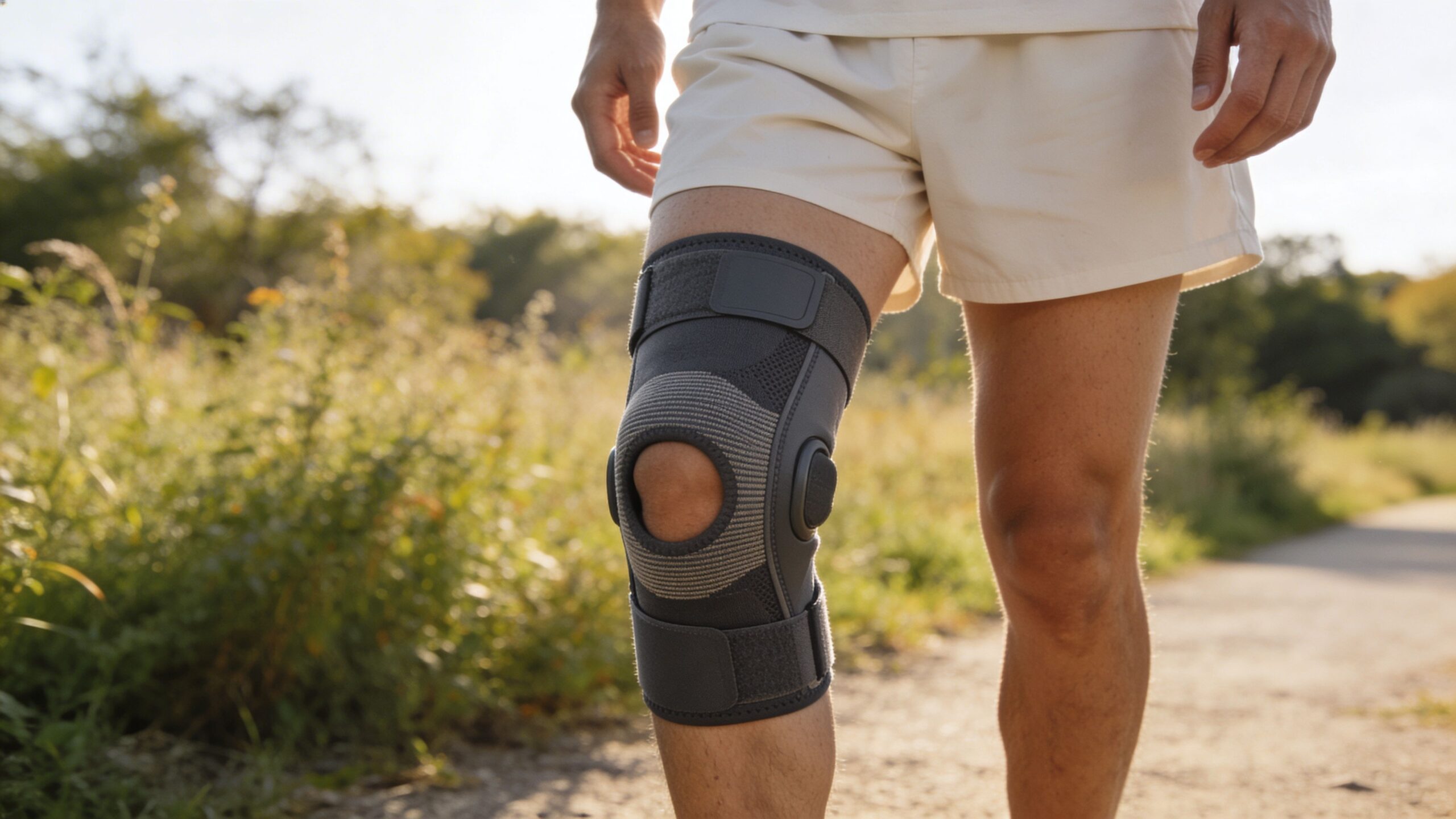
A brace can help. A brace can also become a crutch if it replaces the harder work of rebuilding strength and movement quality.
The key is matching the support to the problem.
What braces do well
Braces can reduce discomfort by improving confidence, limiting aggravating motion, or shifting load away from a painful part of the joint. That makes them useful during flare-ups, longer walks, travel, or transitions back to activity.
The strongest evidence is for unloader braces in knee osteoarthritis. A 2023 meta-analysis of 139 randomized controlled trials involving over 9,600 patients ranked unloader knee braces as the top non-drug intervention for reducing pain, stiffness, and improving daily function (AARP summary of the meta-analysis).
That ranking matters because it separates braces from general “support” advice. Some braces do more than provide compression. They can alter joint mechanics in a way that meaningfully changes symptoms.
Which brace fits which situation
Not every painful knee needs the same device.
| Brace type | Best use | Limitation |
|---|---|---|
| Compression sleeve | Mild swelling, general support, confidence with activity | Limited mechanical unloading |
| Hinged brace | Perceived instability, ligament-related support needs | Bulkier and not always needed for arthritis pain |
| Unloader brace | Osteoarthritis with pain focused to one side of the knee | Requires proper fit and adjustment |
A poor fit can create more irritation than relief. If a brace slides, pinches, or changes your gait for the worse, it is not helping.
Activity modification that helps
Activity modification is not the same as avoiding life. It means reducing unnecessary stress while preserving as much movement as possible.
Useful changes often include:
- Choose flatter routes first: Hills and uneven ground raise demand quickly.
- Shorten the dose before you stop the activity: A ten-minute walk done consistently beats a long walk that causes a two-day flare.
- Use hand support on stairs when needed: This is a strategy, not a failure.
- Change the surface: Softer, more forgiving ground can reduce symptom flare for some people.
- Review footwear: A worn-out shoe changes how force moves through the foot and up to the knee.
- Break up long sitting periods: Stiffness often builds when the knee stays in one position too long.
One trade-off is worth stating clearly. The more external support you use, the more disciplined you need to be with exercise. Otherwise, the brace handles the work your muscles should be learning to do.
Use bracing to stay active while you build capacity, not to avoid building it.
Explore Advanced Non-Surgical and Medical Options
A common pattern looks like this. The knee calms down enough to get through the day, then pain spikes again as soon as walking, stairs, or exercise increase. At that point, the goal is not to chase temporary relief. It is to choose the right medical support, if needed, so rehab can keep building capacity.
That is why these options need to be matched to the problem in front of you. A painful inflammatory flare, persistent osteoarthritis symptoms, and a knee that is deconditioned from months of guarding do not call for the same plan.
A practical comparison of common options
| Option | What it may help with | Main trade-off |
|---|---|---|
| Over-the-counter pain relievers | Short-term symptom control | They do not correct weakness or movement deficits |
| Corticosteroid injections | Flares with strong inflammatory symptoms | Relief may be temporary |
| Hyaluronic acid injections | Some people with osteoarthritis who want a lubrication-focused option | Response is variable |
| PRP | Selected cases where a clinician feels biologic support is appropriate | Cost and insurance coverage can be barriers |
| Genicular artery embolization | Persistent osteoarthritis pain after conservative care | Requires specialist evaluation and is not right for every knee |
Where medication fits
Simple pain relief can help when pain is disrupting sleep, limiting daily tasks, or making it hard to start exercise. Used well, medication creates a window for movement. Used poorly, it just masks the same aggravating pattern.
I tell patients this often. If pain improves but your squat, step-up, walking tolerance, and leg strength do not improve with it, the knee is not more resilient.
Nutrition can also affect how irritable symptoms feel over time. For readers who want a practical starting point, an anti-inflammatory meal plan can complement rehab and activity changes.
Injections work best when they support a plan
Corticosteroid, hyaluronic acid, and PRP injections each have situations where they may help. The better question is what the injection is meant to accomplish.
If the knee is hot, swollen, and highly reactive, reducing inflammation may help someone tolerate daily activity and restart exercise. If the main issue is chronic weakness, poor shock absorption, or a long period of underloading, pain relief alone will not solve it. Capacity still has to be rebuilt.
That is the trade-off patients need to hear clearly. A quieter knee is not the same thing as a stronger knee.
In practice, the strongest results usually come when a procedure supports rehab rather than replacing it. That can include tools such as blood flow restriction training for strength gains with less joint stress, especially when a painful knee cannot yet tolerate heavier loading.
GAE as a possible middle-ground option
For some people with moderate to severe knee osteoarthritis who have already completed a real course of conservative care, genicular artery embolization, or GAE, may come up in discussion with a physician. It is a minimally invasive procedure aimed at reducing pain related to inflammation around the arthritic joint.
What matters here is patient selection. GAE is not a reset button for cartilage loss, and it does not replace the work of restoring strength, mobility, and confidence with movement. It may, however, lower symptoms enough for walking and exercise to become realistic again.
That is the standard I use when thinking about advanced care. If a procedure helps a patient return to progressive loading, it may be worth discussing. If it becomes a substitute for rebuilding capacity, results usually stall.
Begin Your Recovery Journey with Highbar Physical Therapy
The strongest non-surgical plan is the one you can follow. That usually means it is specific, progressive, and adjusted to how your knee responds from week to week.
A licensed physical therapist helps sort out what type of knee pain you are dealing with, which movements are aggravating it, and what level of loading your joint can tolerate right now. That matters because the same exercise can be helpful for one patient and poorly timed for another.
What expert guidance changes
A good evaluation looks beyond the spot that hurts. It checks how the hip, ankle, foot, balance, walking pattern, and daily habits affect the knee. It also identifies what you can do immediately, not just what to avoid.
That is often the turning point. People stop bouncing between rest and overdoing it. They start working from a plan.
Helpful physical therapy for knee pain relief without surgery often includes:
- Individualized exercise progression: Not generic handouts alone
- Hands-on treatment when needed: To improve mobility and reduce guarding
- Movement retraining: For walking, stairs, squatting, and return to recreation
- Clear flare-up guidance: So one bad day does not derail the whole process
- Progress tracking: Based on function, not just pain levels
When surgery is still part of the conversation
Conservative care is not about pretending surgery is never needed. Some knees have advanced structural change, instability, or persistent functional loss that eventually make surgery the right choice.
The value of physical therapy is that it helps you make that decision from a stronger position. You learn what improves, what does not, and whether the joint still has room to recover without an operation. If surgery does become the next step, entering it stronger and more informed usually helps.
The goal is not to avoid surgery at all costs. The goal is to avoid unnecessary surgery and exhaust the options that can help first.
If your knee pain is limiting work, exercise, sleep, or simple daily routines, the next move should be specific. Get assessed. Start the right level of loading. Build from there.
If you are ready to start a structured plan for Highbar Physical Therapy, schedule an evaluation and get a personalized path for knee pain relief without surgery. A physical therapist can identify the source of your symptoms, guide your exercise progression, and help you return to the activities that matter most.